
Zhongshan Xiaolan Town Jianbin Hardware Products Factory
lndustry leading caster manufacturer
How to Choose the Right Iron Castors?
Choosing Iron Castors is less about selecting the toughest-looking wheel and more about matching it to the job. Cast-iron wheels can support substantial loads and resist wear, but their hard tread may mark delicate flooring or transmit vibration. There is no perfect wheel for every floor. The right choice depends on the load, environment, travel distance, and surface beneath it.
Begin by checking the total load, including the equipment and its contents. Divide it across the castors, then allow a practical safety margin for uneven floors and sudden movement. Wheel diameter matters, too: larger wheels usually pass over joints and small obstacles more easily. Consider whether the unit needs swivel castors for tight turns, fixed castors for straight travel, or brakes to help keep it in place. Small details matter.
The working environment can change the recommendation. Moisture, chemicals, heat, and frequent cleaning may affect the wheel, bearing, and mounting hardware differently. Confirm the fixing type and available space before ordering; a suitable wheel is no help if its plate or stem does not fit. Floor protection also deserves attention, especially in workshops with polished concrete, tiles, or coated surfaces. Iron Castors may be a sound choice for rugged settings, but not always for sensitive floors. A supplier’s load rating and material details are useful starting points, not substitutes for checking actual conditions. This guide explains how to compare these factors, spot common sizing mistakes, and choose a castor that works reliably without buying more capacity than the application needs. I would still verify the final selection against the equipment’s real operating conditions.
Understanding Iron Castors and Their Main Types
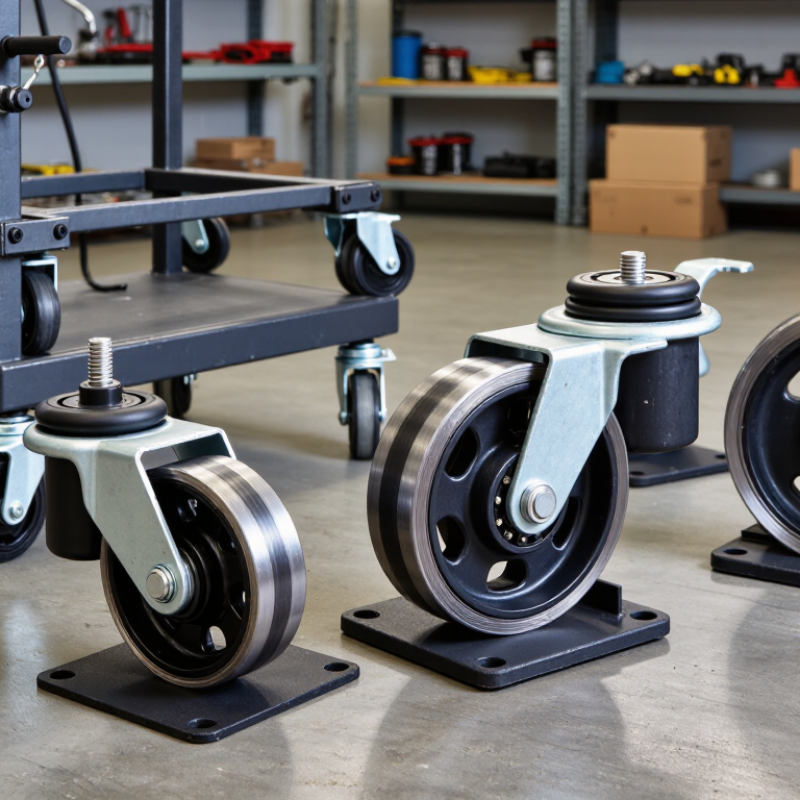
Iron castors use iron wheels, often cast iron, to carry heavy loads in workshops, warehouses, and industrial spaces. Their hard, solid wheels resist wear under substantial loads, but they can mark delicate floors and create a sharp rumble on concrete. They are noisy. Check the floor surface before choosing them; capacity alone does not tell the whole story.
Castors are commonly divided by how they move. Rigid castors travel in a straight line and suit carts that follow fixed routes. Swivel castors turn freely, making it easier to steer around shelving or tight corners. A swivel castor with a brake can hold a cart in place, though some brakes lock only the wheel, not the swivel. Check the mechanism itself.
Wheel construction matters too. A solid iron wheel is durable, while some designs pair an iron core with a softer tread to reduce noise and floor wear. That option may not suit every load or environment. Compare the rated capacity with the cart’s total weight, including its contents, and allow for uneven floors or sudden movement. People sometimes focus too much on maximum load. Fitting, wheel diameter, and mounting space deserve equal attention.
How to Choose the Right Iron Castors? – Understanding Iron Castors and Their Main Types
| Castor Type | Typical Construction | Key Characteristics | Common Applications | Points to Consider |
|---|---|---|---|---|
| Solid iron wheel | A solid cast-iron wheel fitted to a fixed or swivel castor frame. | Rigid, wear-resistant, and suitable for heavy loads and high temperatures. It does not compress like a soft-tread wheel. | Industrial equipment, foundry handling, and other applications on robust floors. | Can be noisy and may damage or mark delicate floors. Check floor condition and impact levels. |
| Fixed iron castor | Iron wheel mounted in a non-swivelling frame. | Travels in a straight line and provides predictable tracking. | Carts and equipment that mainly move along straight routes. | Pair with swivel castors when the equipment needs easier steering or turning. |
| Swivel iron castor | Iron wheel in a frame that rotates around a vertical swivel axis. | Allows equipment to change direction and manoeuvre in tighter spaces. | Heavy-duty carts, machinery, and mobile industrial fixtures. | Steering effort and stability depend on the layout, load distribution, and castor design. |
| Grooved iron wheel | Iron wheel with a shaped groove intended to run on a compatible rail or track. | Guided travel can help keep equipment aligned on the specified track. | Track-guided trolleys and industrial rail systems. | Match the groove profile and wheel dimensions to the track; it is not a general-purpose floor wheel. |
| Flanged iron wheel | Iron wheel with one or more raised flanges designed to engage a compatible rail. | The flange helps guide the wheel along a rail when the assembly is correctly matched. | Rail-guided carts and fixed-path material-handling systems. | Confirm rail dimensions, flange geometry, and alignment before selecting. |
| Iron castor with brake | A fixed or swivel iron castor fitted with a brake mechanism; designs may lock the wheel, swivel, or both. | Helps prevent unintended movement when engaged on a suitable surface. | Mobile workstations, carts, and equipment that need to remain stationary during use. | Check the brake style, operating access, and whether it is suitable for the floor and application. |
Selection note: Confirm the required load rating for the complete castor assembly, wheel diameter, mounting method, operating temperature, floor condition, and expected travel path. Published load ratings and temperature limits vary by design and manufacturer.
Related Posts
-
China Top Heavy Castor Wheels Manufacturer Supplier
-
Understanding the Benefits and Applications of Iron Castor Wheels in Everyday Life
-

Top Quality Antique Metal Casters for Global Buyers?
-
Top 10 Iron Casters Manufacturers Worldwide?
-
Exploring the Impact of Heavy Caster Wheels on Industrial Efficiency: Trends and Innovations
-
2026 How to Choose the Best Caster Swivel Wheel for Your Needs?